Why most IMGs miss NHS jobs even before they apply?
Most IMGs miss jobs because they see the vacancy too late, apply too slowly, or enter a highly saturated applicant pool after hundreds of other doctors have already submitted their applications.
Many international medical graduates (IMGs), especially those in junior levels, spend months applying for roles without a single shortlist. Over time, this creates frustration, burnout, and self doubt. In fact, many applicants are completely unaware that timing plays a much bigger role than people think.
Non-training junior doctor jobs are extremely competitive these days. From our dataset, the most recent 20 junior doctor roles that did not require NHS experience were posted and closed between 15 minutes to 57 minutes. Other vacancies may remain open for weeks, but recruiters may already have enough strong applications long before the closing date arrives.
According to GMC's Workforce report in 2025, only 13% of IMG PLAB joiners in 2024 got a job within 6 months of registration.
13%.
Imagine 8 IMGs that have just passed PLAB 2, standing together in a group. Only one is securing a job within 6 months.
This is one reason why many IMGs feel confused when they apply to large numbers of jobs but rarely hear back. The issue is not always qualifications. Sometimes the application simply entered the queue too late.
Why NHS Junior Doctor Jobs Become Saturated So Quickly
One of the biggest reasons NHS junior doctor jobs have become so saturated is the huge number of overseas IMGs trying to build a better future in developed countries like the UK.
For many doctors coming from developing countries, working in the NHS is not just about getting another job. It represents financial stability, career progression, safer working conditions, stronger training opportunities, and a better long term future for themselves and their families.
In countries such as India, Pakistan, Nigeria, and Egypt, junior doctors often face difficult working environments, limited postgraduate opportunities, lower salaries, and intense competition for training pathways. Because of this, thousands of IMGs look towards the UK every year as a way to improve both their professional and personal lives. In 2025, over 8,700 doctors passed PLAB 2, illustrating a clear demand to work in the UK.
The financial difference alone can be life changing. As of 2026, 1 GBP is roughly equivalent to around ₹115 to ₹120 INR depending on exchange rates. This means even an NHS junior doctor salary can convert into several times more purchasing power compared to salaries earned in many developing countries.
Naturally, this creates enormous competition for NHS vacancies, especially for:
- SHO jobs
- Junior clinical fellow posts
- FY1-3 equivalent jobs
Many of these roles are attractive because they offer a realistic entry point into the NHS for doctors without previous UK experience. As a result, vacancies receive hundreds of applications very quickly after being posted.
This explains why many IMGs feel trapped in a cycle of endless applications without interviews. By the time they discover the vacancy through manual searching, WhatsApp groups, Facebook posts, or delayed email digests, the post is already heavily saturated or worse, closed.
Why IMGs Often Discover Jobs Too Late
Most IMGs rely on slow job discovery methods:
- Checking job boards manually once or twice daily
- Scrolling through Facebook groups
- Waiting for recruitment agencies to send vacancies
- Using delayed email notifications
- Relying on friends to share openings
The problem is simple. NHS vacancies appear continuously but unpredictably throughout the day. New roles can be posted at any time, even midnight. As a junior aspirant, if you only check once daily, more often than not the job listings that you're eligible for have already been closed due to saturation.
Timing matters far more than many doctors realise. Applying too slowly could be the difference between getting shortlisted and never being seen.
Many IMGs Underestimate the Importance of Timing
A strong CV matters. A tailored supporting statement matters. Meeting essential requirements matters too.
But none of these help if a job listing closes before you get to submit your application.
Many job listings have an internal limit on the number of applications. Some even publicise the limit. This means that once a particular job listing receives a certain number of applications, it closes instantly.
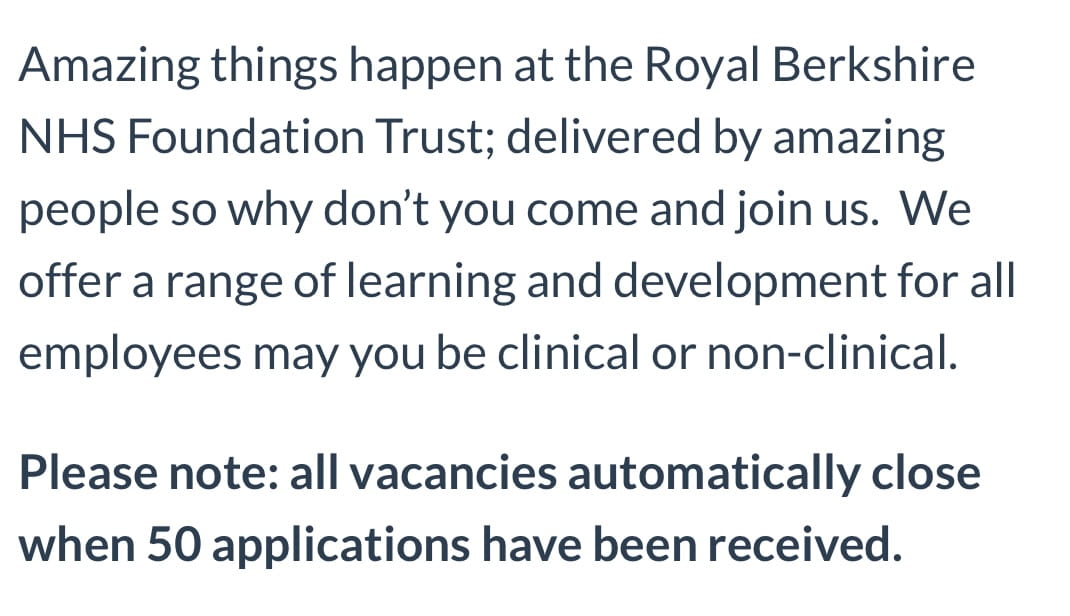
Above: Description from a job listing indicating that vacancy will close after 50 applications
This is why doctors who apply quickly often seem to secure interviews more consistently, even if their CV is not dramatically stronger than everyone else's. They are simply applying to more roles that others do not see.
If you struggle with shortlisting, it is also worth reading about how important essential requirements really are for NHS shortlisting.
Why Manual Job Searching Is Becoming Less Effective
Years ago, NHS recruitment was less saturated. IMGs could apply more slowly and still have a reasonable chance of being reviewed.
Today the market is very different. Large numbers of doctors are applying for:
- Non training jobs
- SHO posts
- Junior clinical fellow vacancies
- FY1-3 equivalent roles
Many IMGs are unemployed for extended periods while searching for NHS work. Some others are trying to secure their first UK role after PLAB 2. These groups of people can be extremely dedicated in their job search process, often spending hours every day on applications, which further increases competition.
Competition has also increased sharply, especially for jobs that:
- Offer visa sponsorship
- Require little to no NHS experience
- Accept overseas experience
- Have straightforward entry requirements
This is one reason why instant job alerts are becoming increasingly important. They reduce the delay between vacancy posting and discovery, and consequently application submission.
How My NHS Job Alerts Help IMGs Apply Earlier
Instant alerts remove the need to constantly refresh job boards manually throughout the day.
Instead of discovering jobs hours later, you receive notifications immediately as vacancies appear. This gives you a chance to:
- Apply before applicant volume becomes overwhelming
- See new vacancies before social media groups spread them widely
- Target fresh jobs with lower initial competition
- Build a more consistent application routine
- Reduce time wasted manually searching multiple websites
For many IMGs, this creates a psychological advantage too. Constantly refreshing job boards is exhausting, discouraging, and a totally brain-dead activity. Real-time alerts simplify the process and make job searching feel more manageable, effective, and efficient.
If you are still manually searching, we have previously wrote about how to search for junior doctor roles effectively as an IMG.
The Best Time to Apply for NHS Jobs
Timing patterns matter more than many people realise.
Based on NHS recruitment behaviour, weekday daytime applications tend to perform better than late night or weekend submissions. Recruiters are more active during working hours, and earlier visibility can improve your chances of being reviewed sooner.
Likewise, weekends are often the worst time to apply for NHS jobs if your goal is maximum recruiter visibility.
Getting Shortlisted Is About More Than Qualifications
Many IMGs believe that additional courses or expensive certifications alone will solve their job search problems. Qualifications help, but they are only one part of the equation, albeit an important part by itself.
But recruiters also consider:
- Whether essential requirements are clearly met
- Whether the supporting statement is tailored properly
- How relevant your experience appears
- How early your application arrives
- Whether the role already has enough strong candidates
This is why some doctors with impressive CVs still struggle to secure interviews. We explored the importance of qualifications (ALS, MRCP, MRCS), and which ones have the highest return on investment.
The Reality Many IMGs Face
Many IMGs spend months applying quietly without success. Some lose confidence after repeated rejections. Others begin questioning whether they are good enough for NHS work despite being fully qualified doctors.
The issue is rarely about competence. It is about competition, visibility, timing, and application strategy.
Understanding how NHS recruitment works allows you to approach the process more strategically instead of relying purely on volume applications.
If you are currently struggling, you are not alone. Many IMGs take months to secure their first NHS role, despite the fact that a sizeable workforce in the NHS is comprised of IMGs.
The Bottom Line
Most IMGs do not miss NHS junior doctor jobs because they are incapable doctors. They miss opportunities because the modern NHS recruitment environment is extremely competitive, highly saturated, and increasingly time-sensitive.
Applying earlier gives you a genuine advantage.
Instant NHS job alerts help reduce the delay between vacancy posting and application submission, allowing you to compete before roles become crowded with applicants.
In a market where hundreds of doctors may apply for the same role, every minute makes a difference.
My NHS Job Alerts was designed specifically to help IMGs discover NHS junior doctor vacancies faster, apply earlier, and improve their chances of getting shortlisted before competition becomes overwhelming.