Why are weekends the worst time to apply for NHS jobs?
You're finally done for the week. A full Saturday and Sunday coming up, perfect to continue your job search grind. Then weeks go by, and you wonder why aren't you shortlisted, at all.
Weekends are a dead zone, according to job listing data that we've collected over more than a year. Almost no postings, near-zero recruiter activity, and a surge of last-minute applicants all combine to make Saturdays and Sundays the most competitive and least effective days to apply.
Why Weekends Are So Bad for NHS Job Applications
Most applicants assume weekends are a good time to apply because they finally have breathing room. However, the NHS recruitment ecosystem simply does not operate on weekends. That mismatch creates a hidden disadvantage for anyone applying during that time.
- Recruiters do not review applications on weekends, causing your submission to sink beneath Monday's surge
- Most job postings appear between 9am and 5pm on weekdays, especially Tuesdays and Wednesdays, meaning weekend applicants are already late
- Popular job listings can disappear within 15 minutes, meaning you don't even see them when weekends come
- Weekend applications often coincide with the highest volume of last-minute applicants, especially IMGs juggling time zones
- Recruiters tend to shortlist early in the posting cycle, not late. Guess who's late? Weekend applicants.
The result? Your application enters the system at the exact moment when it is least likely to be seen early and most likely to be buried.
The Data: What 10,000+ NHS Junior Doctor Listings Reveal
When we plotted posting timestamps across the year, the pattern was obvious. Weekends accounted for less than 0.5% of all postings. Meanwhile, Monday to Thursday accounted for over 80%. This means that by the time the weekend arrives, most roles have already been live for several days, which also meant that early applicants have already been reviewed.
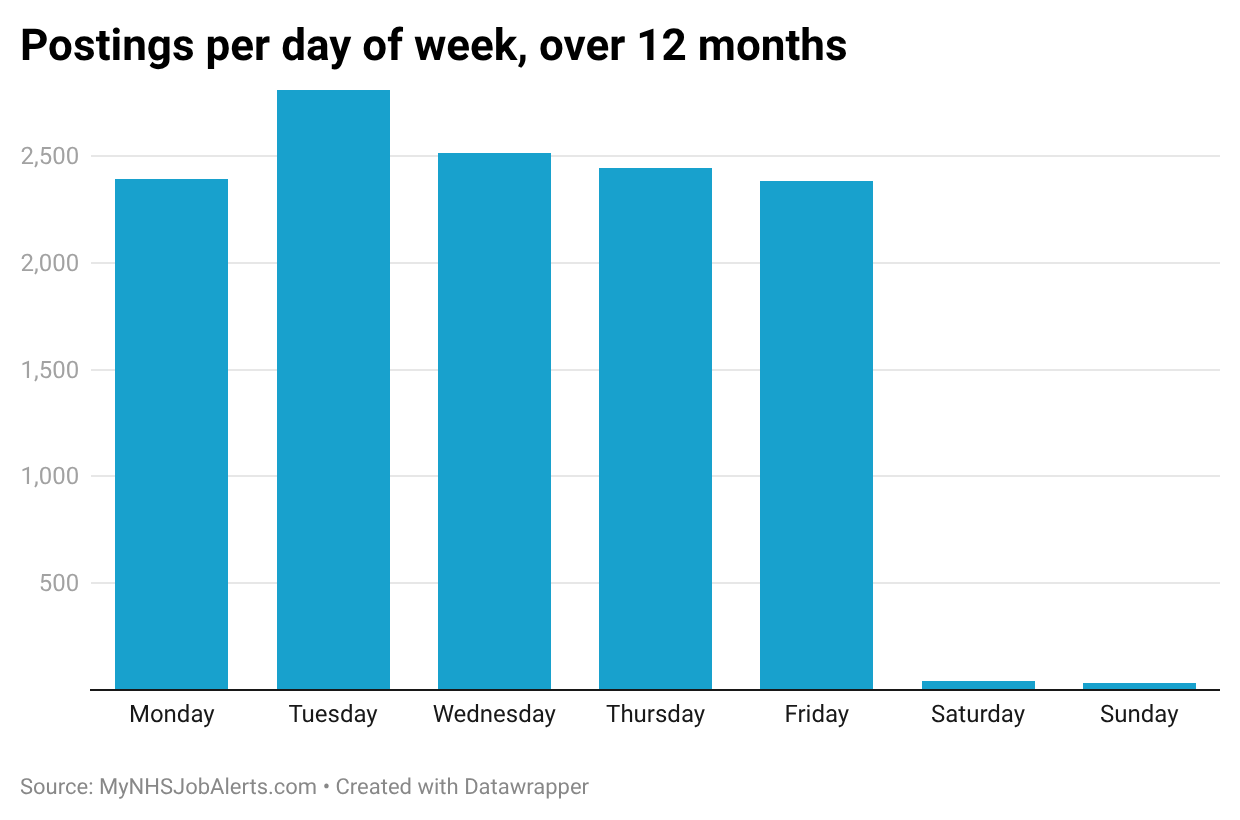
If you apply on the weekend, you are almost never part of the first wave of applications to be reviewed.
Why Recruiters Don't Look at Weekend Applications
NHS recruitment teams are overwhelmingly weekday-based. Even in large teaching hospitals, HR teams rarely process applications outside standard hours. This means:
- Your weekend application sits untouched for 48-72 hours.
- When Monday morning arrives, it is buried under a pile of new weekday submissions.
- Recruiters often shortlist from the top of the queue, meaning earlier weekday applicants get priority.
This is especially painful for overseas applicants, who often only apply on weekends due to time zone differences or work reasons.
Applying on weekends is one of the biggest hidden reasons you're not getting shortlisted.
Why Competition Spikes on Weekends
Weekends are when most junior doctors finally have time to sit down and apply. That means:
- More applicants per role.
- More rushed, last-minute submissions.
- More people applying to the same popular trusts.
In other words: you're applying at the worst time, to the most competitive roles, with the least recruiter visibility.
Why Many NHS Job Postings Disappear Before the Weekend
99.5% of all NHS job postings go live during the weekdays, and the most competitive roles are often reviewed, shortlisted, and quietly closed within hours. By the time Saturday hits, many of the best opportunities have already been filled or removed from public view.
This weekday-only posting pattern creates a hidden disadvantage for anyone who waits until the weekend to apply. If a job goes live at 10:12am on a Tuesday and receives a surge of strong applicants within the first hour, recruiters may begin shortlisting immediately. By the afternoon, the role may already be saturated and a few moments later, it may no longer be visible at all.
- Over 80% of all junior doctor job postings appear Monday to Thursday.
- Only 0.5% of postings appear on weekends, meaning almost all roles are already "old" by Saturday.
- Popular job listings, such as those that do not require NHS experience or provide sponsorship, can disappear within 15 minutes.
This is why weekend applicants are at such a severe disadvantage. They are not just applying late; they are applying after the most competitive roles have already been reviewed, shortlisted, or removed entirely. It's the equivalent of showing up to an interview after the panel has already left the building.
If you've ever wondered why you never see certain job types, or why some roles seem to vanish before you even get a chance to apply, this is the reason. NHS recruitment teams operate on weekday cycles, and the most desirable roles move fast — sometimes faster than anyone expects.
How Fast Roles Can Disappear: The 15-Minute Problem
We have found multiple examples of junior doctor roles that were posted, saturated, and effectively closed within minutes. These were almost always junior roles that had minimal requirements, such as GMC registration.
In several cases, the listings were closed within 15 minutes. Let that sink in. This is why applying fast matters far more than most junior doctors realise.
If you apply on the weekend, you are not just late — you are often applying to roles that have already been filled, shortlisted, or quietly closed days earlier.
Why Applying Early Matters More Than Applying Perfectly
When a job listing goes live, it is hit with a surge of submissions. Recruiters do not have the time to read every application in depth. Instead, they skim the earliest submissions first, spending only a few seconds on each before deciding whether to shortlist or move on.
This creates a harsh but predictable reality: the earlier you apply, the more likely your application is to be seen while the recruiter is still fresh, still attentive, and still actively building the shortlist. Once the application count spikes, the recruiter's behaviour changes. They switch from “reviewing carefully” to “filtering aggressively,” often relying on quick checks of essential requirements, keywords, and recent UK experience.
In other words, applying early doesn't just give you a time advantage; it also gives you a visibility advantage. Your application is reviewed before the recruiter is overwhelmed, before the inbox is flooded, and before the shortlisting criteria tighten.
- Recruiters often spend less than 10 seconds on an initial scan of each application.
- Early applicants are reviewed when the shortlist is still empty — not when it's already full.
- Once a role receives 50-100 applications, recruiters begin to filter more aggressively and swiftly
- Late applicants are more likely to be rejected without a full read, even if they are technically strong.
This is why "perfecting" your application matters far less than submitting it early. A beautifully written supporting statement submitted on Saturday evening is far less likely to be seen than a solid, well-structured application submitted within the first hour of the job going live. Unfortunately the difference is not quality — it's timing.
When recruiters are reviewing early applications, they are open-minded, curious, and actively searching for strong candidates. When they are reviewing late applications, they are tired, overloaded, and filtering ruthlessly. This is basic psychology.
This is where instant alerts shine. They allow you to apply during the crucial early window: before the application count explodes, before the recruiter becomes selective, and before your chances quietly drop without you ever realising it happened.
How Instant Alerts Solve the Weekend Problem
The only reliable way to avoid the weekend disadvantage is to apply as soon as a job goes live. Instant alerts give you that advantage by notifying you the moment a role is posted, even if it's exactly 11:03am on a random Tuesday.
Instead of waiting until the weekend, you apply during the golden window when recruiters are actively reviewing applications. This alone can increase your shortlisting chances dramatically.
- Apply within minutes, not hours or days.
- Beat the weekend surge of applicants.
- Stay ahead of IMGs applying across time zones.
- Avoid missing roles that close early or fill before the deadline.
What You Should Do Instead of Applying on Weekends
If you want to maximise your chances of getting shortlisted, shift your application strategy to match recruiter behaviour. Based on our dataset:
- Apply on weekdays whenever possible.
- Avoid waiting until weekends to apply.
- Prioritise roles posted within the last few hours.
- Use instant alerts service to catch new postings immediately.
The difference between applying on a Saturday vs applying on a Tuesday morning right after the job is posted can genuinely be the difference between getting shortlisted and getting ignored.
Summary
Weekends feel convenient, but they are statistically the worst time to apply for NHS jobs. Recruiters aren't reviewing applications, new postings are rare, and competition spikes. If you want to maximise your chances, apply early, apply fast, and apply during the week.
Instant alerts give you that advantage by ensuring you never miss the crucial first-review window again. Instead of joining the weekend rush, you'll be at the front of the queue — where most shortlisting actually happens.