Which months have the most junior doctor roles?
March, April, August, October. Some months are better than others when it comes to finding NHS junior doctor jobs. Nevertheless, that should not stop you from applying all year round.
For this post, we analysed 1,800+ NHS junior doctor job listings from My NHS Job Alerts that specifically required under 2 years of clinical experience for the past year. Our goal was simple: identify when opportunities peak, when competition tends to increase, and which months are usually quieter for applications.
It turns out that NHS hiring is not evenly distributed throughout the year. There were far more job listings in certain months than others.
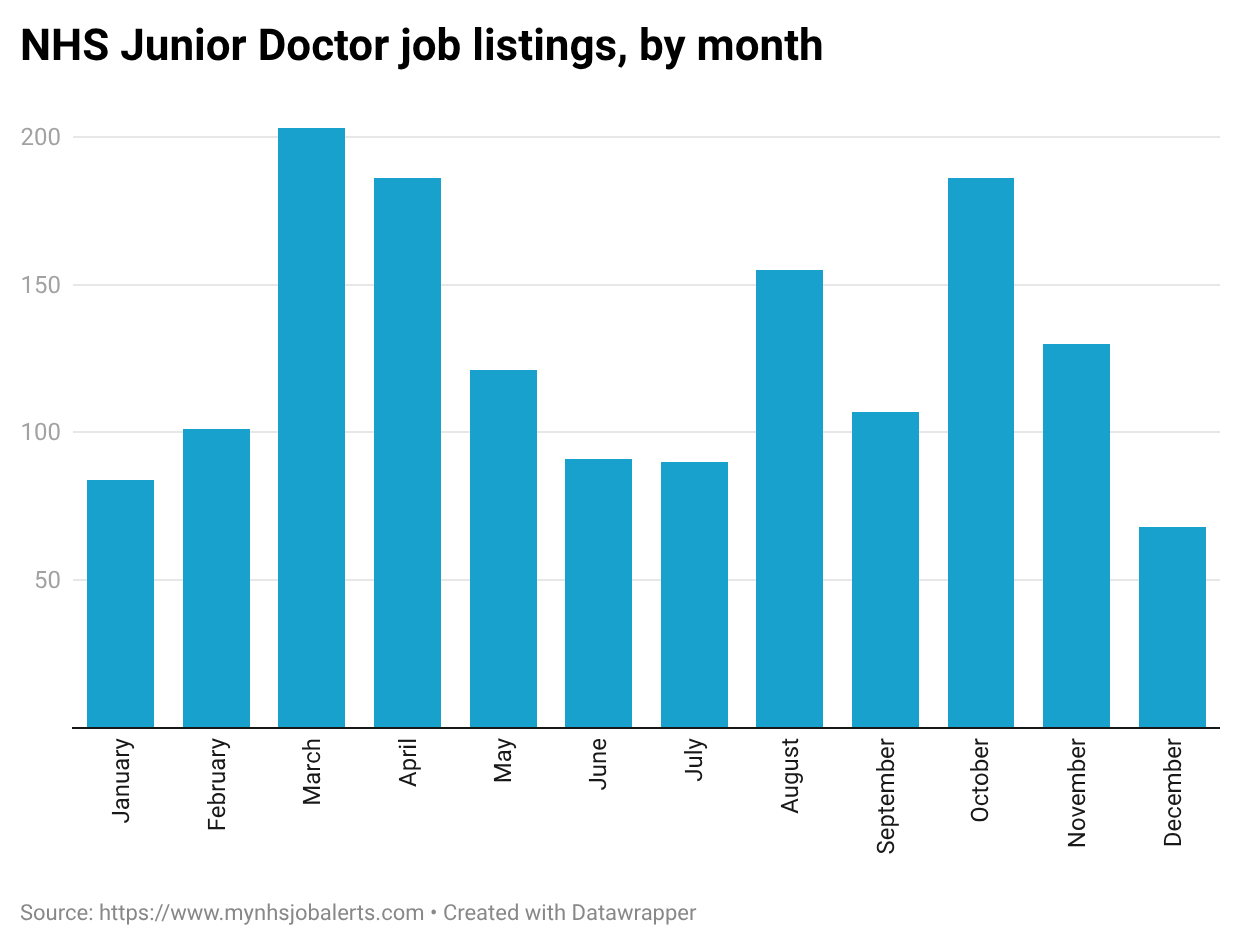
- March recorded the highest number of listings at 203 listings
- April and October were also major hiring months with 186 listings each
- December had the lowest number of listings with only 68 vacancies
- August showed a sharp increase compared to June and July, likely due to NHS rotation periods
- January and February were relatively quiet
Monthly Breakdown of NHS Junior Doctor Jobs Requiring Less Than 2 Years of Experience
Here is the breakdown of job listings that were captured across the year:
- January: 84 listings
- February: 101 listings
- March: 203 listings
- April: 186 listings
- May: 121 listings
- June: 91 listings
- July: 90 listings
- August: 155 listings
- September: 107 listings
- October: 186 listings
- November: 130 listings
- December: 68 listings
The numbers show that hiring activity rises and falls in waves, depending on the month.
Why March and April Usually See Huge Spikes in Junior Doctor Hiring
March and April were the strongest hiring months in our dataset. Together, they accounted for almost 400 listings requiring under 2 years of clinical experience.
There are a few reasons why this tends to happen.
First, NHS trusts begin preparing for upcoming rota gaps well before the August changeover period. Departments already know which doctors are leaving, progressing into training, relocating, or finishing contracts. Recruitment activity starts increasing several months earlier to avoid staffing shortages.
Second, trusts often become more aggressive with recruitment before the summer because onboarding, references, visa processing, and pre-employment checks can take time. This especially affects IMG applicants.
Third, many departments prefer to secure candidates early before vacancies become harder to fill closer to rotation dates.
This is also why applying quickly matters. By the time a role has been live for several days, there may already be hundreds of applicants in the queue.
Why August Is Another Strong Month for Junior Doctor Vacancies
August recorded 155 listings, making it another strong period for entry-level junior doctor opportunities.
This is closely linked to the NHS training rotation cycle. August is one of the biggest transition periods in the NHS calendar. Large numbers of doctors rotate into new posts, finish contracts, or move into training programmes.
Whenever this happens, gaps naturally appear across departments.
Some trusts manage recruitment well in advance. Others end up posting urgent vacancies much closer to the rotation period after internal staffing plans change unexpectedly.
For IMGs, August can actually be a surprisingly good time to apply because departments may prioritise filling rota gaps quickly rather than waiting for the "perfect" candidate.
This becomes especially important in specialties that already struggle with staffing shortages.
If you want to understand which specialties consistently hire the most junior doctors, read: Top 10 NHS Specialties Hiring the Most Junior Doctors in 2026.
Why June and July Tend to Slow Down
June and July were noticeably quieter, with both months sitting around 90 listings each.
This may seem strange at first because August is such a major transition period. But in reality, many trusts have already started recruiting earlier in March and April.
By June, a large number of departments may already have shortlisted or secured candidates for upcoming posts.
Another factor is application saturation.
Popular junior doctor vacancies often attract huge numbers of applicants very quickly, especially in larger cities and well-known trusts (hint: London). Some trusts may close listings early once enough suitable applications are received.
This is one reason why relying on manual job searches can become risky.
Jobs can disappear before applicants even notice them. Our post on the importance of applying fast explains this trend in more detail.
Why December Is Usually the Worst Month to Apply
December had the lowest number of listings in the entire dataset with only 68 vacancies. This is not surprising.
Recruitment activity across the NHS tends to slow down significantly during the Christmas and New Year period. HR teams operate with reduced staffing, interview scheduling becomes harder, and departments often postpone non-urgent recruitment decisions until January.

Many IMGs continue applying aggressively during December without realising the overall market is quieter.
That does not mean opportunities disappear completely. There are still jobs available. The issue is simply that total vacancy volume becomes much lower.
A quieter market also means each role can feel more competitive because there are fewer openings available overall. It is important to understand that it is not impossible but merely harder during dry months, and to manage your expectations accordingly.
What This Means for IMGs Applying for NHS Jobs
Timing alone will not guarantee interviews, but it absolutely affects how many opportunities are available to you.
If you apply during high-volume periods like March, April, August, and October, you simply have more chances to find roles matching your experience level.
This matters even more for doctors with:
- Zero to limited NHS experience
- Less than 2 years of clinical experience
- Gaps in employment history
- Limited postgraduate qualifications
- Restricted location preferences
During stronger hiring months, trusts often become more flexible because they need to fill larger numbers of vacancies.
You should also pay close attention to essential requirements. Many applicants waste time applying for roles where they clearly do not meet the minimum criteria.
The Real Advantage Is Seeing Jobs Early
One of the biggest takeaways from this data is that high-volume months also tend to move faster.
More vacancies often means more applicants actively monitoring NHS job boards. Popular SHO and trust grade roles can become saturated surprisingly quickly, especially in London and larger teaching hospitals. Our dataset has shown that popular junior-level job listings, especially those that do not require NHS experience, can close within 15 minutes.
That is why IMGs that rely on instant job alerts, instead of manually refreshing job boards, have a distinct advantage over the rest.
Applying early does not guarantee a shortlist, but it improves the chances of getting your application seen before the vacancy becomes crowded.
As a consequence, applicants should also be aware that weekends are objectively the worst time to apply for NHS jobs.
The Bottom Line
The NHS junior doctor job market follows seasonal patterns that are not immediately obvious to IMGs. March, April, August, and October consistently produced the highest number of job listings requiring under 2 years of clinical experience.
December, January, and early summer were noticeably slower.
For IMGs, understanding these hiring cycles can make job searching far more efficient. Instead of applying blindly throughout the year, you can prioritise the limited amount of time you have to prepare documents, improve your CV, and position yourself better ahead of high-volume hiring periods.
More importantly, you need visibility on vacancies as soon as they appear.
My NHS Job Alerts helps junior doctors discover new NHS junior doctor roles instantly so they can apply before listings become saturated or close early.