Top 10 NHS specialties hiring the most junior doctors in 2026
A practical, data-driven guide to understanding NHS job trends and how to use them to your advantage.
Over the past year, we analysed 2,500+ strictly entry-level junior doctor NHS job listings using My NHS Job Alerts, categorising them by specialty and frequency. What emerged wasn't just a set of numbers, but insights on where opportunities cluster, which specialties recruit most aggressively, and how doctors can position themselves to land roles faster. This post walks you through those insights in a grounded, realistic way, helping you make sense of the job market.
Why Understanding Specialty Demand Matters
Different NHS specialties have very different levels of hiring demand. Some specialties post large numbers of junior doctor vacancies throughout the year, while others may only open a small number of roles each month. At the same time, many prospective junior doctors understandably want to target only specific specialties that align with their long-term career goals.
There's nothing wrong with being selective. In fact, focusing on a specialty you genuinely want to build a career in can be the right long-term decision. But it's also important to understand the trade-off: the fewer vacancies a specialty has, the longer it may take to secure a role in that field. For IMGs, in the worst case this can take years.
Understanding specialty demand helps you set realistic expectations, plan your application strategy more effectively, and decide whether to stay highly targeted or widen your search temporarily to gain NHS experience faster.
For example, if you're early in your UK journey, you might find it helpful to know more about how to search more effectively for junior doctor roles before diving into specialty-specific strategies. Understanding the broader system makes the specialty data even more useful.
What the Data Shows: The Most Active Specialties
After categorising over 2,000 strictly entry-level junior doctor job titles over the past year, we see that certain specialties dominate the listings. Here's a simplified snapshot of the top 10 specialties:
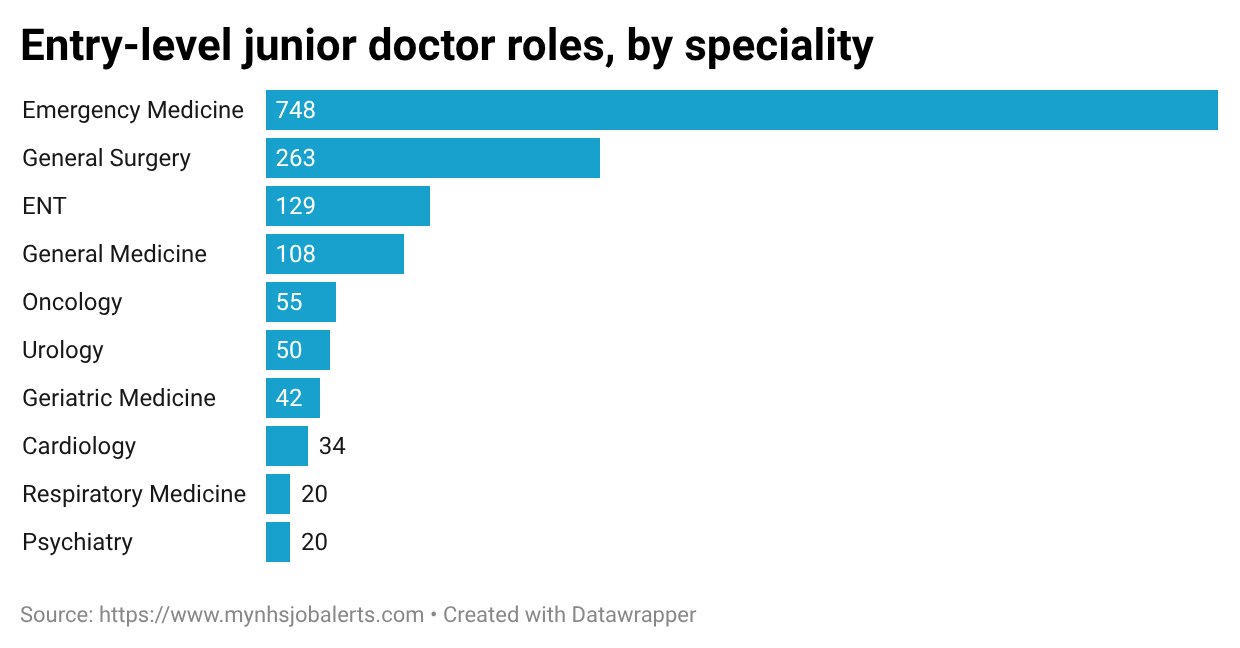
- Emergency Medicine — consistently the highest volume
- General Surgery — broad, with many subspecialty variants
- ENT — surprisingly active for junior roles
- General Medicine — steady and predictable
- Oncology — growing demand across the UK
Understaffed Emergency Departments have been a longstanding issue since before COVID-19, so it is not surprising that Emergency Medicine continues to top the chart for the highest number of NHS junior doctor job listings between 2025 and 2026. Contributing factors include high attrition rates, heavy workloads, and ongoing staff dissatisfaction.
Emergency Medicine: The Clear Front-Runner
Emergency Medicine isn't just busy, it's structurally designed to recruit continuously. High turnover, rota gaps, and the need for round-the-clock coverage mean trusts post EM roles almost daily. For junior doctors, this creates a unique advantage: you can apply frequently, learn from each interview, and secure a post without waiting months for the next opening.
EM also tends to be more flexible with backgrounds. Many IMGs and UK grads alike use it as a stepping stone into the NHS because the exposure is broad, the learning curve is steep, and the experience transfers well into other specialties. If you're unsure where to begin, EM is often the most forgiving entry point.
One thing that often gets overlooked is the number of locum opportunities in EM. Because departments run 24/7 and rota gaps appear constantly, EM ends up offering far more flexible shifts than most other specialties. For IMGs, this can be a real advantage. Adhoc locum work pays significantly higher hourly rates (up to 2x), and because the demand never really dips, you can build up earnings quickly while still settling into the NHS system. Many doctors use locums as a bridge: it gives them financial breathing room, and helps them understand how UK hospitals actually function. In the short term, it's one of the most reliable ways to boost income while strengthening your portfolio, and in the long term it gives you a foundation that transfers well into almost any specialty.
General Surgery: High Volume, High Variety
General Surgery is another specialty with a strong presence in junior-level recruitment. What makes it interesting is the variety: colorectal, upper GI, HPB, bariatric, breast, vascular-adjacent roles, and mixed surgical services posts all fall under this umbrella. This means you're not applying to one type of job, but also to a family of related roles.
If you're planning a surgical career, this is where you can build a strong foundation. Even if you're undecided, surgical posts often offer structured rotas, clear responsibilities, and exposure to acute care that strengthens your portfolio.
ENT: The Quietly Active Specialty
ENT often surprises applicants. They're not the first specialty people think of when applying for junior roles, yet they consistently appear in job alerts. These departments tend to be smaller, but they recruit regularly because they rely heavily on junior doctors to keep clinics, theatres, and emergency referrals running smoothly.
For doctors who prefer a balance between procedural work and clinic-based medicine, ENT offers a sweet spot. They're also known for being supportive environments for IMGs, especially those who want hands-on experience without the intensity of major surgical specialties.
General Medicine: The Backbone of the NHS
General Medicine form the backbone of inpatient care. It recruits steadily throughout the year, and they're often the first to open additional posts during winter pressures.
If you're aiming for Internal Medicine Training (IMT), these roles are invaluable. They give you exposure to acute care, ward management, and multidisciplinary teamwork, which are all essential for a strong IMT application.
How to Use This Data to Your Advantage
Knowing which specialties recruit most frequently helps you prioritise your applications. But the real value comes from combining this data with your own goals, as well as to manage your expectations. Here are a few practical ways to use these insights:
- Apply early in high-volume specialties to maximise interview chances
- Use lower-volume specialties as strategic "backup" options
- Tailor your answers in Trac to match the specialty's expectations
- Track your own application outcomes to refine your approach
- Use instant alerts to avoid missing short-lived postings
Not sure if certain certifications help in your application? Lucky you, because we have analysed the number of junior doctor job listings that require ALS or membership exams.
Summary
The NHS job market isn't chaotic — it's patterned. Once you understand which specialties recruit most often, you can approach your job search with far more clarity and purpose. Regardless of specialty, the key is to apply strategically rather than reactively.