The biggest mistake IMGs make: Spending too long on each application
Many IMGs spend hours perfecting a single NHS application, only to never hear back. In reality, speed and consistency often matter far more than trying to make every application perfect.
One of the hardest truths about the NHS job market is that applications are often a numbers game. Many IMGs assume that if they spend enough time refining every little detail in their application, they will eventually get shortlisted. While this may be true, it is an inefficient use of time, and applicants should not be wasting time considering that it usually takes months to secure a first NHS job.
Almost all NHS junior doctor roles receive hundreds of applications. Some jobs become completely saturated within hours. Hiring teams are under pressure, recruiters are busy, and many applications are filtered quickly. This means that being early, consistent, and visible often gives IMGs a much bigger advantage than endlessly polishing one application.
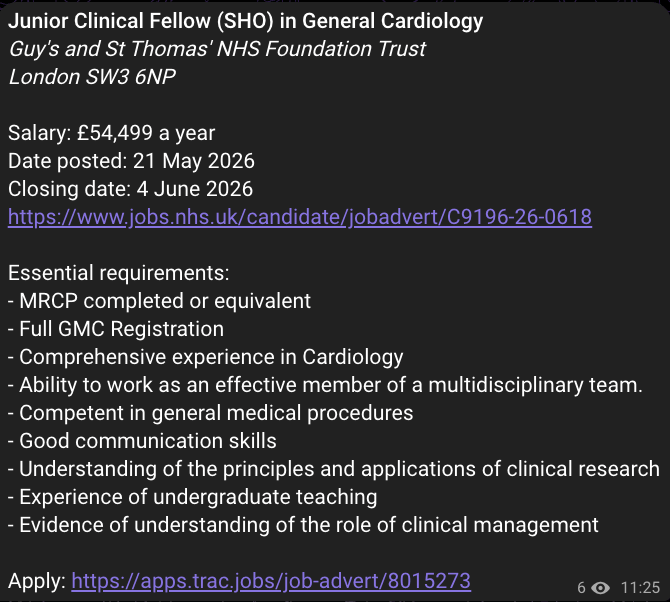
(added: 21 May) Above: A Junior Clinical Fellow role was posted on 11:25am
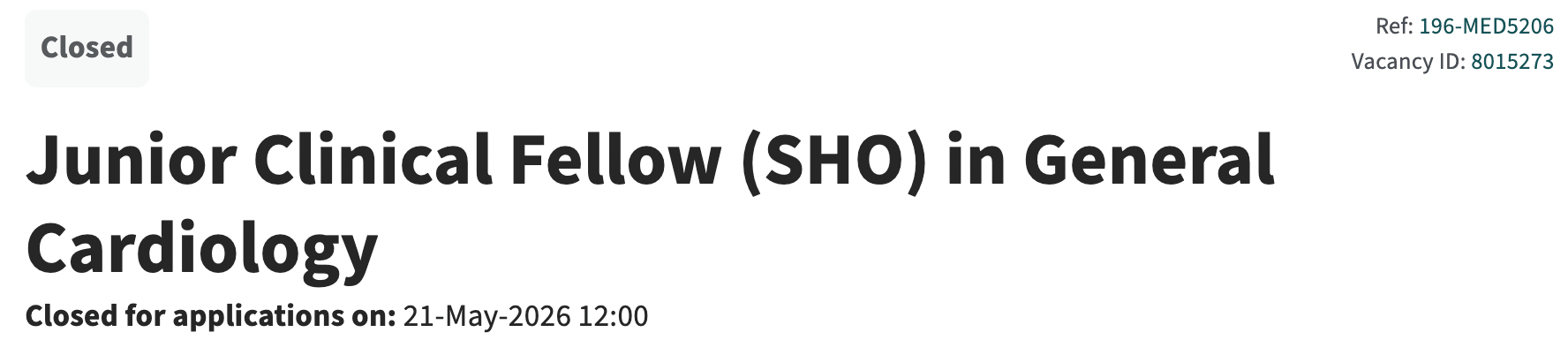
(added: 21 May) Above: Job listing was officially closed at 12pm in Trac, which means applicants only have half an hour to detect and submit their application
Why IMGs Spend Too Long on Applications
Most IMGs, being doctors by training, are extremely hardworking, conscientious, and often perfectionists. They tend to approach the job search and application process as if they're still in medical school; treating every single job application as a test, or an exam to get perfect scores on.
This mindset usually comes from fear:
- Fear of rejection
- Fear of missing requirements
- Fear of wasting applications
- Fear that one small mistake will ruin their chances
- Fear that they are already disadvantaged as IMGs
Because of this, many doctors spend:
- Hours on one supporting statement
- Hours researching a single trust or role
- Too much time rewriting identical sections
- Hesitating for hours or even days before clicking submit
While all these are happening, hundreds of other applicants have already submitted their applications. IMGs often underestimate how competitive even non-training jobs have become. By the time they submit their perfect application, the job posting has become so saturated that their application may not be seen at all.
The NHS Recruitment Process Rewards Speed More Than Many IMGs Realise
Many IMGs believe that recruiters carefully study every single application in detail. However, recruitment teams are often overwhelmed with volume.
Some NHS jobs receive applications continuously from the moment they are posted. If a role has already attracted a substantial pool of candidates early, trusts may become more selective later in the process even before the closing date. This is why applying early matters so much.
The truth is simple:
- Earlier applications are often reviewed earlier
- Popular jobs become saturated quickly
- Delayed applications face heavier competition
- Some recruiters already identify preferred candidates early
- Fast applicants naturally apply to more opportunities overall
Quantity Creates More Opportunities to Learn
Another reason IMGs should avoid over-perfectionism is because volume creates learning opportunities.
Many doctors think they must fully optimise each applications before sending them out. But in reality, improvement usually happens through repetition and feedback.
Doctors who apply to many NHS jobs start noticing patterns:
- Which supporting statements generate interviews
- Which types of trusts respond more frequently
- Which specialties are easier to enter
- What keywords to look out for when browsing listings
- How recruiters phrase shortlisting criteria
- What questions are typically asked in Trac
This practical feedback loop is incredibly valuable. Someone who submits 80 applications will learn far more about the NHS job search process than someone who only submits 8 "perfect" applications.
As an IMG, you should familiarise yourself with how you can search for junior doctor roles effectively.
Perfectionism Often Hides Fear of Rejection
This is something many IMGs rarely talk about openly.
Sometimes spending excessive time on applications is not actually about quality. It is about avoiding rejection.
Subconsciously, many doctors feel that if they keep improving the application, they can delay the possibility of hearing "no".
But NHS recruitment does not work like an exam where one perfect answer guarantees success. There are too many variables that are not within their control:
- Luck
- Timing
- Competition level
- Recruiter preferences
- Trust priorities
- Internal candidates
- Visa considerations
- Previous NHS experience
This means ghosting and rejections are completely normal and expected, especially for IMGs entering the system for the first time. The sooner applicants come to terms with this fact, the sooner they can begin applying more efficiently and effectively. Remember, it's more of a numbers game.
If you want perspective on timelines, take a look at how long IMGs usually take to get NHS jobs.
Most NHS Applications Are More Similar Than IMGs Think
Another major mistake is rebuilding every application from scratch.
In practice, all junior doctor applications share the same copy-pasted structures:
- Commitment to patient safety
- Communication skills
- Teamwork examples
- Audit and QI experience
- Teaching experience
- Clinical exposure
- Career motivation
Of course, some tailoring is important, particularly when it comes to hard essential requirements. But spending hours rewriting the same concepts creates very little to no additional value for the amount of time invested.
Strong, successful applicants often develop:
- A master supporting statement
- Prepared answers for all commonly-asked questions
- Prepared audit descriptions
- Reusable teaching examples
- A fast editing workflow
This allows them to apply rapidly without sacrificing overall quality. With the advent of free generative AI tools such as ChatGPT and Copilot, there is absolutely no reason for applicants to spend too much time perfecting each application.
According to our most successful users, it's recommended to spend at most 5-10 minutes on straightforward applications where you can copy-paste everything, and up to 30 minutes for everything else, no more than that. This ensures that you're only spending at most 12 hours a week if applying to 100 roles a month, equivalent to a casual part-time job.
Applying to More Jobs Increases Statistical Odds
This sounds obvious, but many IMGs emotionally resist doing so.
Each application has a low probability of being shortlisted due to saturation, even if each application is painstakingly curated and perfectly tailored for a specific job listing. Therefore, increasing the number of reasonable-quality applications naturally improves overall chances.
For example:
- 5 applications may produce no interviews
- 50 applications may produce 1 or 2 interviews
- 100 applications may create multiple interview opportunities
Realistically, IMGs should be applying to every single role that they're eligible for. According to our dataset, there's usually about anywhere between 50 to 150 entry-level junior doctor job listings each month.
This does not mean sending careless applications for the sake of bumping up raw numbers. It means avoiding perfectionism that destroys speed and consistency.
Many applicants wrongly assume that stronger candidates only apply selectively, but the fact is that successful candidates tend to apply broadly, even to roles that they may not want in order to gain interviewing experience. Remember that virtual interviews are essential free for interviewees.
Additionally, for the first cut, recruiters often spend less than 10 seconds on each application. This means that the perfect application that you have meticulously crafted for hours could potentially be dismissed in mere seconds — a poor return on investment.
Some Essential Requirements Matter Less Than You Think
Another reason IMGs delay applications is because they assume they must meet every single requirement perfectly before applying.
But NHS recruitment is rarely that rigid.
While there are certain essential requirements that are absolutely non-negotiable (e.g., medical degree), there are also subjective requirements that are less rigid.
Many candidates still get shortlisted despite missing:
- Specific audits
- Certain courses
- Exact specialty exposure
- Preferred qualifications
- Ideal NHS experience levels
If you meet the core criteria and can demonstrate safe clinical practice, it is often still worth applying. The key strategy is to apply to every role at your level, but spend less time on each listing when you meet fewer of the essential requirements.
Smart IMGs Optimise for Speed and Consistency
The NHS job search process is basically a game of optimisation, given certain constraints. The most effective applicants are usually not the ones obsessing over tiny wording details, which has diminishing returns.
Instead, they optimise for:
- Instant discovery of new jobs
- Early application timing
- Consistent daily applications
- Reusable application systems
- Broad application coverage
Timing matters enormously, especially if your goal is to get shortlisted for interviews in the first place.
You should also have a basic understanding of the best time to apply for NHS jobs as an IMG and why weekends are often the worst time to apply for NHS jobs.
How Instant NHS Job Alerts Help IMGs Apply Faster
One major reason IMGs apply slowly is because they discover jobs too late. Most IMGs have their day jobs in their home country, and do not have the luxury of time to refresh several job boards every minute to identify newly posted job listings.
By the time many doctors manually check job boards during break time or when they're back home:
- The listing already has heavy competition
- Hundreds of applicants may have applied
- The best application window is long gone
Instant alerts change this completely.
Instead of manually refreshing job sites day after day, opportunities come to you immediately. This allows you to:
- Apply within minutes of jobs going live
- Increase overall application volume
- Reduce missed opportunities
- Build a more consistent application routine
- Stay ahead of saturated listings
Summary
The biggest mistake IMGs make is believing that the key to success is writing the perfect application for each and every single job listing. However, in today's NHS job market, such perfectionism can be a major obstacle to securing that first NHS job.
The doctors who eventually succeed are usually the ones who:
- Apply consistently
- Apply early
- Learn through repetition
- Adopt smarter systems
- Keep moving on despite rejections
Other than one outlier from South East Asia that only had a total of 80 applications before securing his first FY2 role, every single junior doctor that we personally knew had submitted hundreds of applications in total each before receiving their first interview opportunity. This highlights the importance of quantity.
Your application does not need to be flawless. It only needs to be strong enough, submitted early enough, and repeated consistently enough to create momentum.
That is why instant alerts can become such a powerful advantage for IMGs struggling to break into the NHS system.